Inbound vs Outbound Sales for B2B: Which Strategy Wins in 2026?
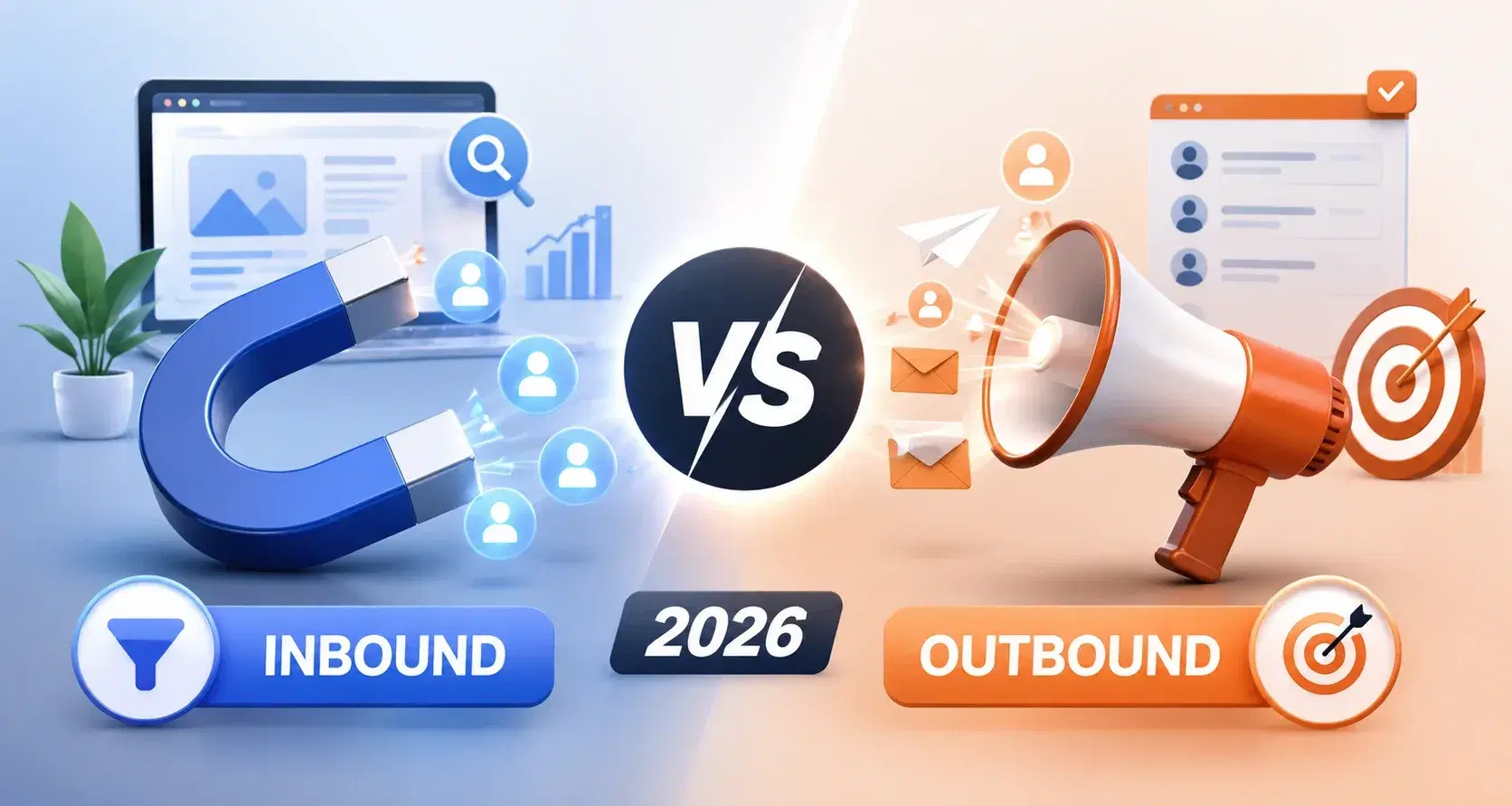
The hybrid approach wins. Neither inbound nor outbound alone drives consistent B2B pipeline in 2026.
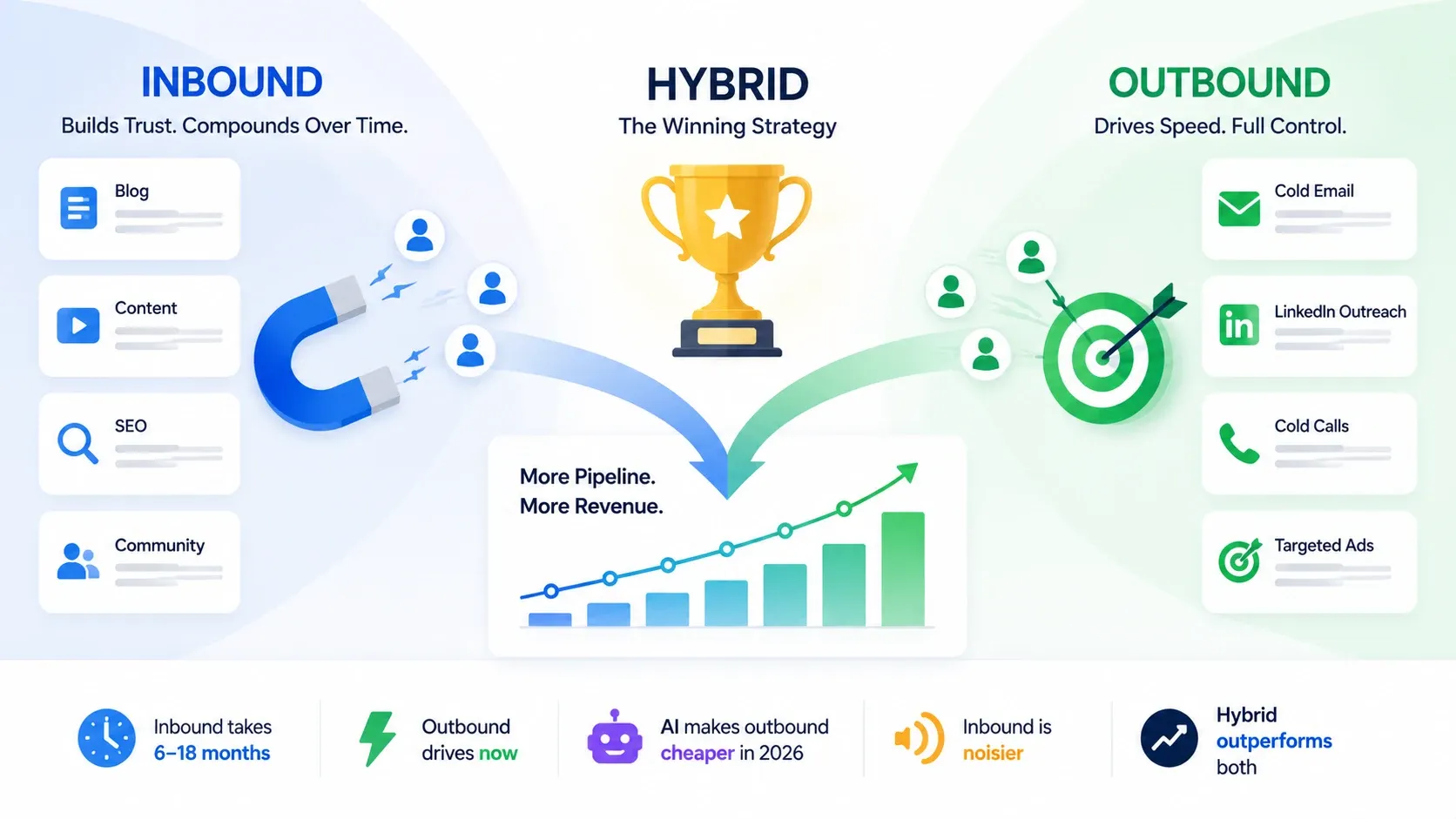
The teams generating the most revenue are blending both using inbound to build trust and outbound to control timing.
If you are running one strategy in isolation, you are leaving pipeline on the table.
TL;DR
- Inbound builds compounding pipeline. It takes 6 to 18 months to generate consistent leads you cannot wait that long if you need revenue now.
- Outbound delivers speed and targeting control. You choose exactly who you talk to and when.
- In 2026, AI has made outbound cheaper to run and inbound noisier to compete in. That shifts the math for both.
- The hybrid model outbound for speed, inbound for scale outperforms either channel running alone.
- Most B2B teams at seed and Series A stage need to lead with outbound while inbound builds.
What Is Inbound Sales for B2B?
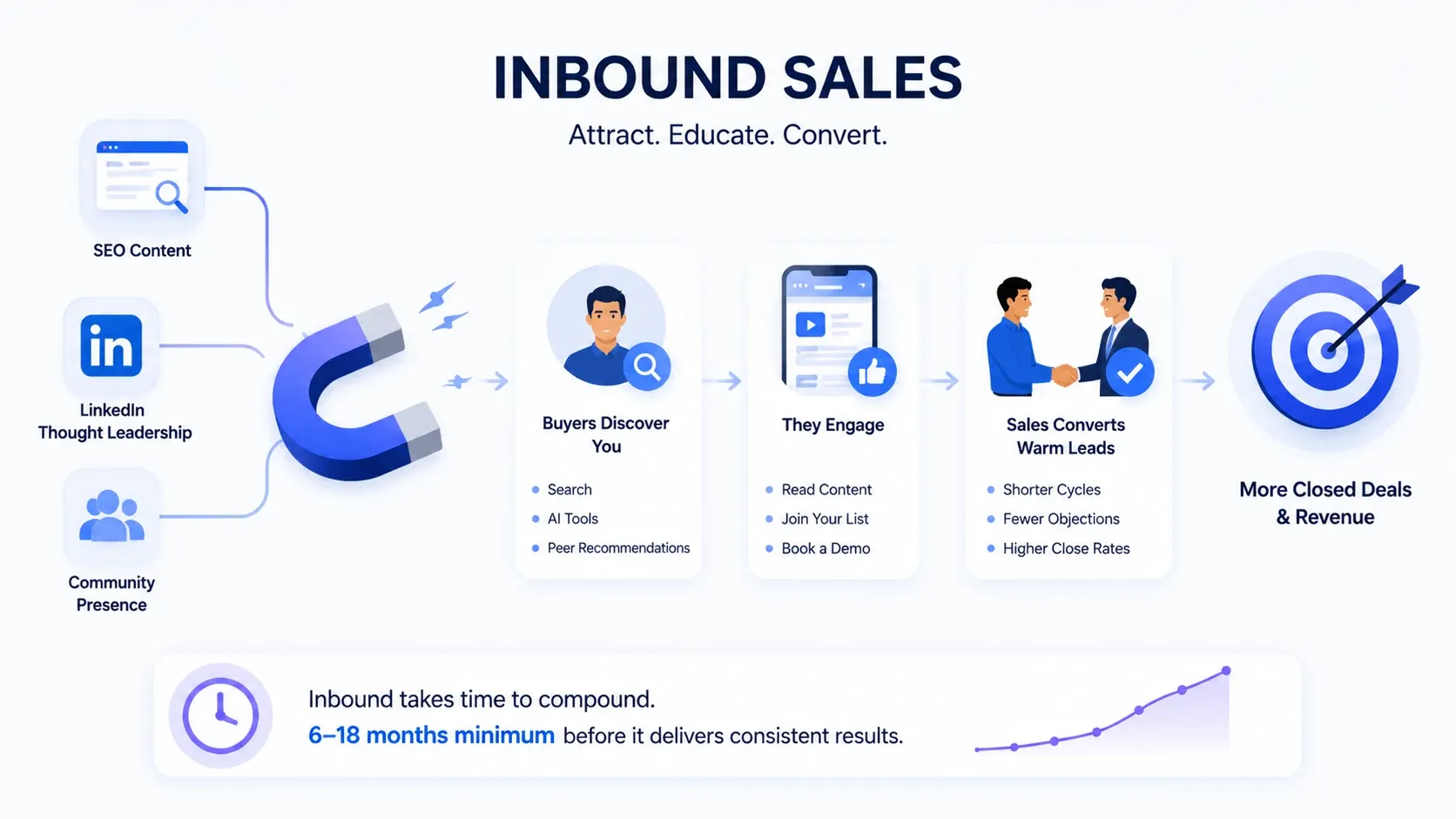
Inbound sales means attracting buyers to you so they arrive pre-educated, already aware of the problem, and ready to talk.
The core mechanics:
- → Publish SEO content, run LinkedIn thought leadership, build community presence
- → Buyers discover you organically through search, AI tools, or peer recommendations
- → They engage with your content, join your list, or book a demo
- → Your sales team converts warm leads with shorter cycles and fewer objections
From my experience, inbound leads close faster and at better rates.
When a buyer comes inbound, they have already done a chunk of the research. The sales cycle is shorter. The objections are fewer.
The problem? You need 6 to 18 months minimum before inbound starts compounding. For a seed-stage B2B company with 90 days of runway, that timeline does not work.
What Is Outbound Sales for B2B?
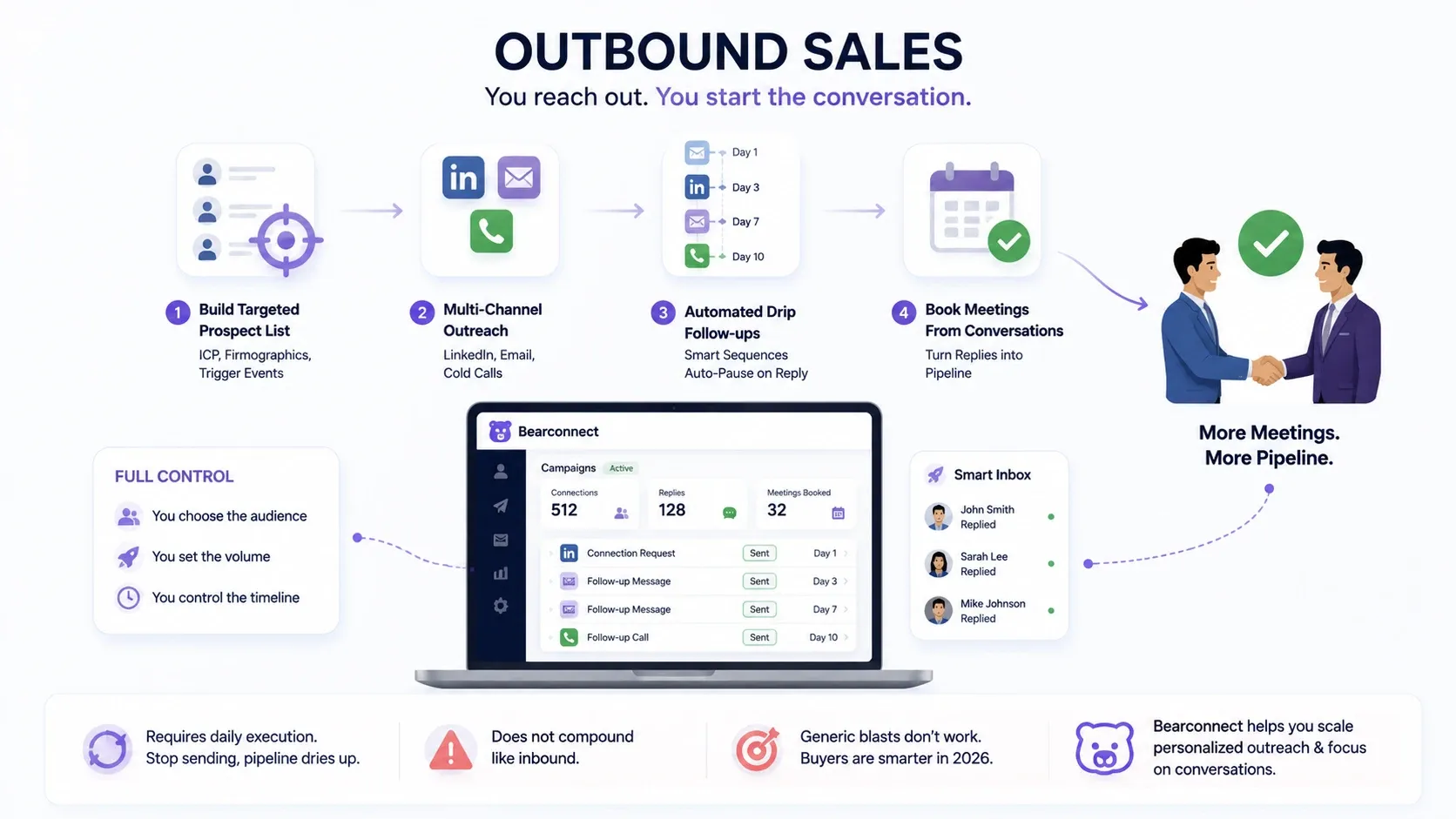
Outbound sales means you pick your target, write the message, and start the conversation. No waiting for them to find you.
The core mechanics:
- → Build a targeted prospect list based on ICP firmographics and trigger events
- → Run multi-channel outreach: LinkedIn connection requests, cold email, cold calls
- → Follow up with drip sequences that pause automatically when a prospect replies
- → Book meetings directly from the first conversation
Outbound gives you full control. You decide the volume, the audience, and the timeline.
The catch? Outbound requires consistent daily execution. Stop sending and the pipeline dries up within weeks.
It does not compound the way inbound does. A generic blast does not work anymore buyers in 2026 are sharper than ever.
This is where tools like Bearconnect make the difference. Bearconnect enables LinkedIn outreach at scale with personalised sequences, multi-account management, and smart inbox workflows so your outbound team focuses on conversations, not copy-pasting messages all day.
Is Inbound the Same as Demand Generation? (And Is Outbound the Same as Lead Gen?)
Not exactly and confusing these four terms leads to bad strategy decisions.
- Demand generation creates awareness and interest in a problem your product solves. It includes both inbound content and outbound ads.
- Lead generation captures contact information from interested buyers. It can happen via inbound forms or outbound sequences.
- Inbound is the methodology: pull buyers to you using content and brand.
- Outbound is the methodology: push your message to targeted buyers proactively.
The clearest way to think about it: demand gen is the fire, lead gen is the bucket. Inbound and outbound are the two ways you build the fire.
How Has the B2B Buyer Journey Changed in 2026?
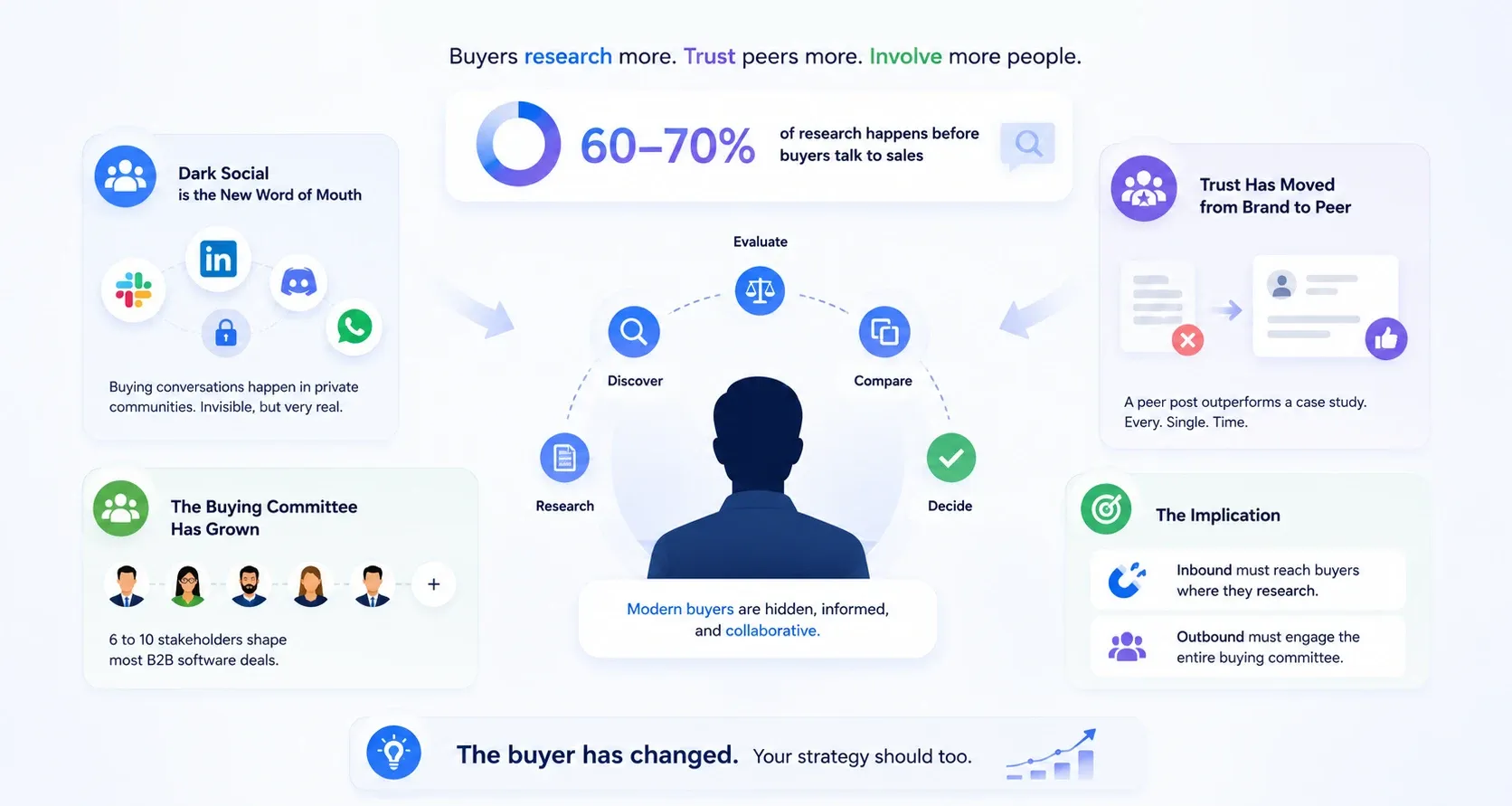
B2B buyers in 2026 complete 60 to 70 percent of their research before ever talking to a salesperson and the channels where they research have shifted significantly.
This is the core reason the inbound vs outbound debate has changed. The buyer has changed.
Here is what is different now:
- Dark social is the new word of mouth. Slack communities, private LinkedIn DMs, Discord servers, and WhatsApp groups are where B2B buyers share recommendations. This buying conversation is invisible to your analytics but very real.
- Trust has moved from brand to peer. A LinkedIn post from a founder who used your product outperforms a case study PDF from your marketing team. Every time.
- The buying committee has grown. In 2026, the average B2B software deal involves 6 to 10 stakeholders. A single outreach thread to one decision-maker is rarely enough.
The implication: inbound needs to reach buyers where they now research. Outbound needs to cover the full buying committee, not just one contact.
Inbound vs Outbound Sales for B2B: Pros and Cons
Most teams learn this the hard way. Here is the honest side-by-side before you commit budget or headcount.
Inbound sales pros and cons
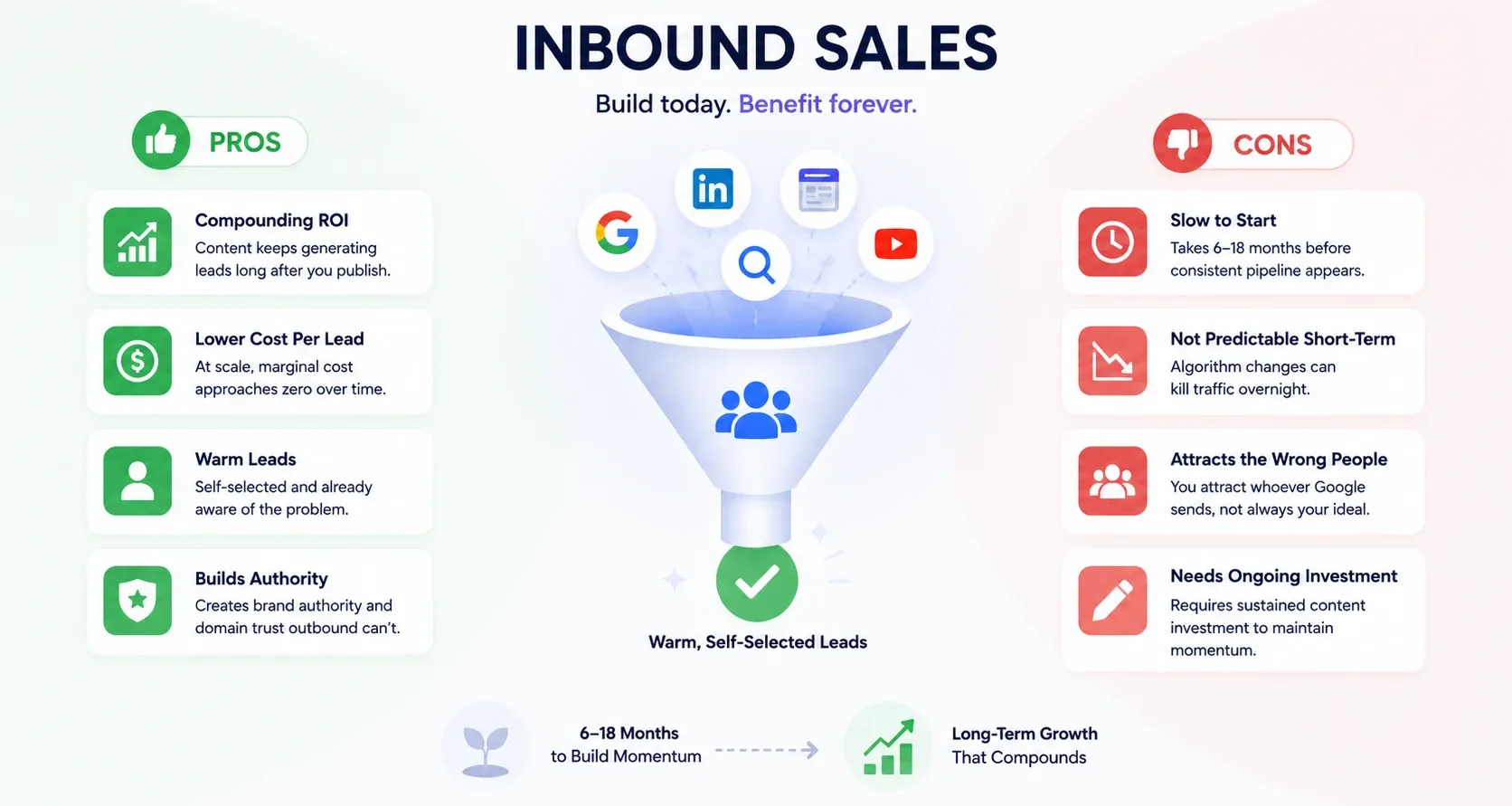
Pros:
- → Compounding ROI: content keeps generating leads long after you publish it
- → Lower cost per lead at scale marginal cost approaches zero over time
- → Warm leads who self-selected, already aware of the problem
- → Builds brand authority and domain trust that outbound cannot replicate
Cons:
- → Slow to start: 6 to 18 months before consistent pipeline appears
- → Not predictable short-term: algorithm changes can kill traffic overnight
- → You attract whoever Google sends, not always your ideal buyer
- → Requires sustained content investment to maintain momentum
Outbound sales pros and cons
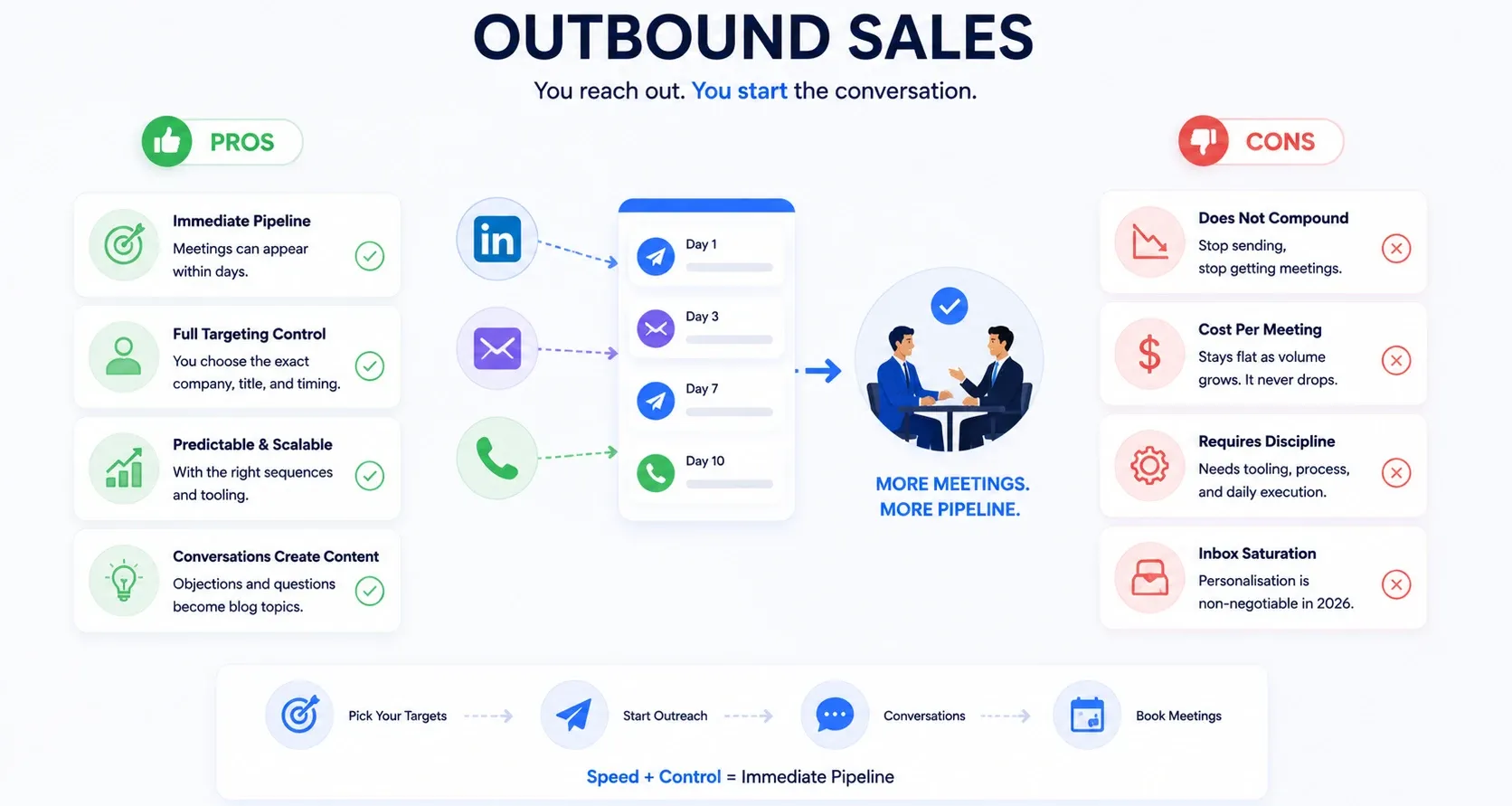
Pros:
- → Immediate pipeline: meetings can appear within days of launching
- → Full targeting control: you choose the exact company, title, and timing
- → Predictable and scalable with the right sequences and tooling
- → Every conversation feeds insight back into content (objections become blog topics)
Cons:
- → Does not compound: stop sending, stop getting meetings
- → Cost per meeting stays flat as volume grows it never drops
- → Requires discipline, tooling, and daily execution to sustain
- → Inbox saturation means personalisation is non-negotiable in 2026
Inbound vs Outbound Sales: Head-to-Head Comparison
The fundamental difference is who initiates the conversation and when.
| Factor | Inbound | Outbound |
|---|---|---|
| Who initiates | The buyer | Your team |
| Speed to pipeline | 6 to 18 months | Days to weeks |
| Cost per lead (early stage) | Higher | Lower |
| Cost per lead (at scale) | Drops over time | Stays flat |
| Lead intent | High (they came to you) | Varies by targeting quality |
| Targeting control | Low Google/LinkedIn decides | High you choose exactly |
| Scalability | High (content compounds) | Moderate (effort scales linearly) |
| Avg close rate | Higher (pre-educated buyers) | Lower (cold to warm conversion needed) |
| Compounding effect | Strong | None |
| Best for | Brand authority, PLG, scale | Speed, new markets, ABM |
Most outbound teams get the best results by combining cold calling with LinkedIn, because a warm profile view makes the call far less cold.
Is Cold Outreach Still Effective in B2B in 2026?
Yes but cold outreach effectiveness in 2026 depends entirely on how it is executed, not whether it is used.
The spray-and-pray era is over. Sending 500 identical connection requests and waiting for replies does not work.
What does work:
- Tight ICP targeting. Message relevance starts with list quality. A bad list makes great copy useless.
- Multi-touch sequences. A single LinkedIn message is not outbound. A 5 to 7-touch sequence across LinkedIn and email is.
- Personalisation at scale. AI tools now let you personalise outreach messages based on the prospect's profile, recent post, or company news. Generic gets ignored.
- Fast follow-up on replies. The first team to respond wins most deals. A unified inbox across all outbound accounts eliminates the delay.
From my experience, teams that run outbound with the right tooling, targeting, and follow-up system still see 20 to 30 percent LinkedIn connection acceptance rates and 5 to 10 percent reply rates. That is a healthy pipeline engine.
Cold outreach is not dead. Lazy cold outreach is dead.
When Should You Use Outbound? Best-For Guide
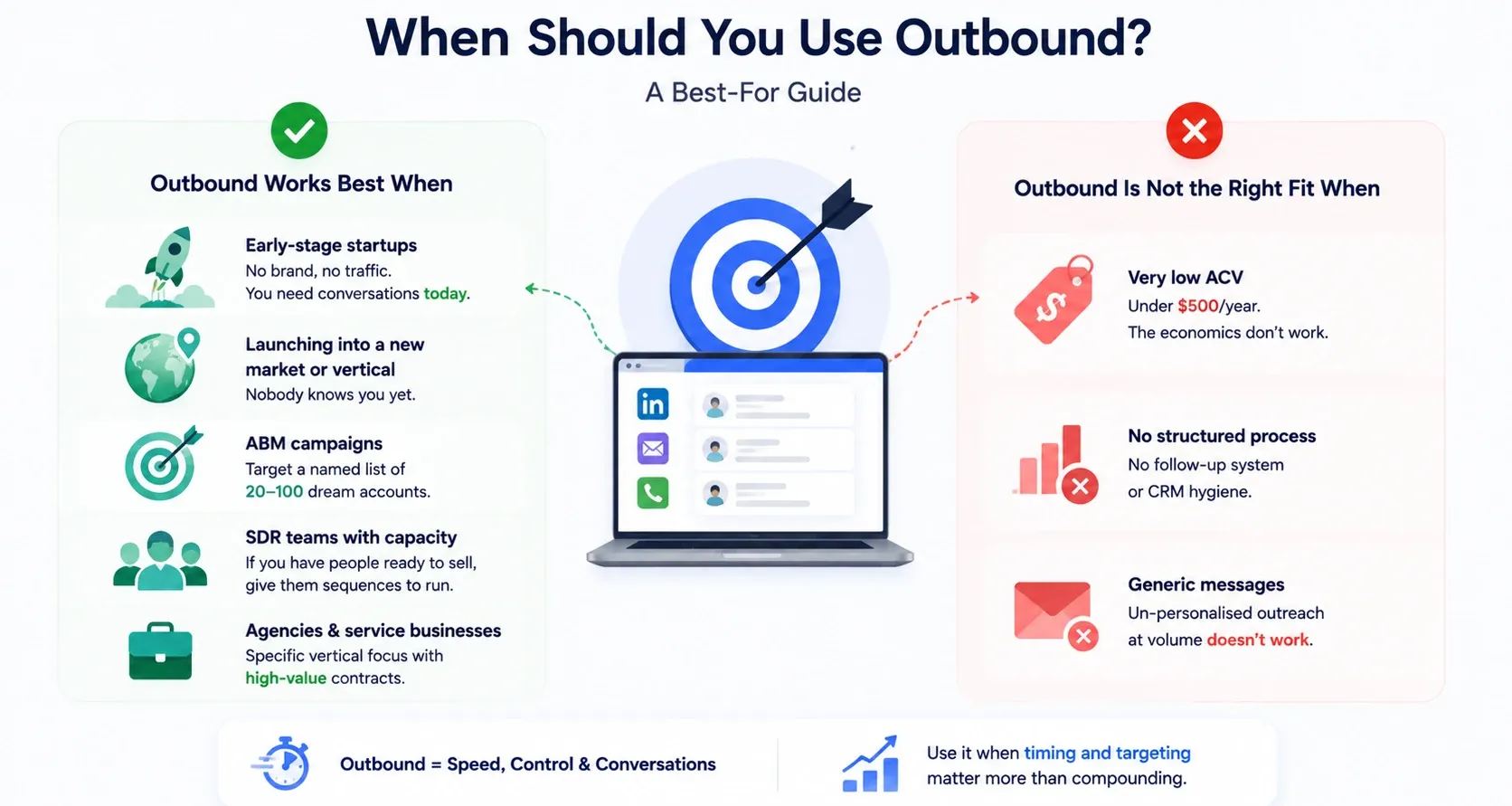
Outbound is the right primary strategy when you know your ICP clearly and you cannot afford to wait for organic demand to build.
Outbound works best for:
- Early-stage startups with no brand awareness and no organic traffic you need conversations today, not in six months
- Launching into a new market or vertical where nobody knows you yet
- Account-based marketing (ABM) campaigns targeting a named list of 20 to 100 dream accounts
- SDR teams with capacity. If you have people ready to sell, give them sequences to run.
- Agencies and service businesses with a specific vertical focus and high-value contracts
Outbound is not the right fit when:
- Your product has a very low ACV (under $500 per year) the economics do not work
- Your team has no structured follow-up process or CRM hygiene
- You are sending generic, un-personalised messages at volume
The real problem with most outbound in 2026 is not the channel. It is lazy execution.
When Should You Use Inbound? Best-For Guide
Inbound is the right primary strategy when your market is actively searching for a solution and your brand has some existing authority.
Inbound works best for:
- Established companies with a recognisable brand your name alone drives search volume
- Product-led growth models your product has a free tier or demo flow that inbound content can drive signups into without SDR involvement
- Niche markets with high search volume where buyers are actively Googling the problem you solve
- Teams optimising for long-term CAC reduction once the content engine runs, the marginal cost of each new lead approaches zero
Inbound is not the right fit when:
- You are pre-revenue and need pipeline in 30 to 60 days
- Your product solves a problem buyers do not know they have yet
- Your ICP is a very small, highly specific group under 5,000 total addressable accounts
- Your content budget is under $2,000 per month
Inbound vs Outbound by Company Stage: Which to Prioritise
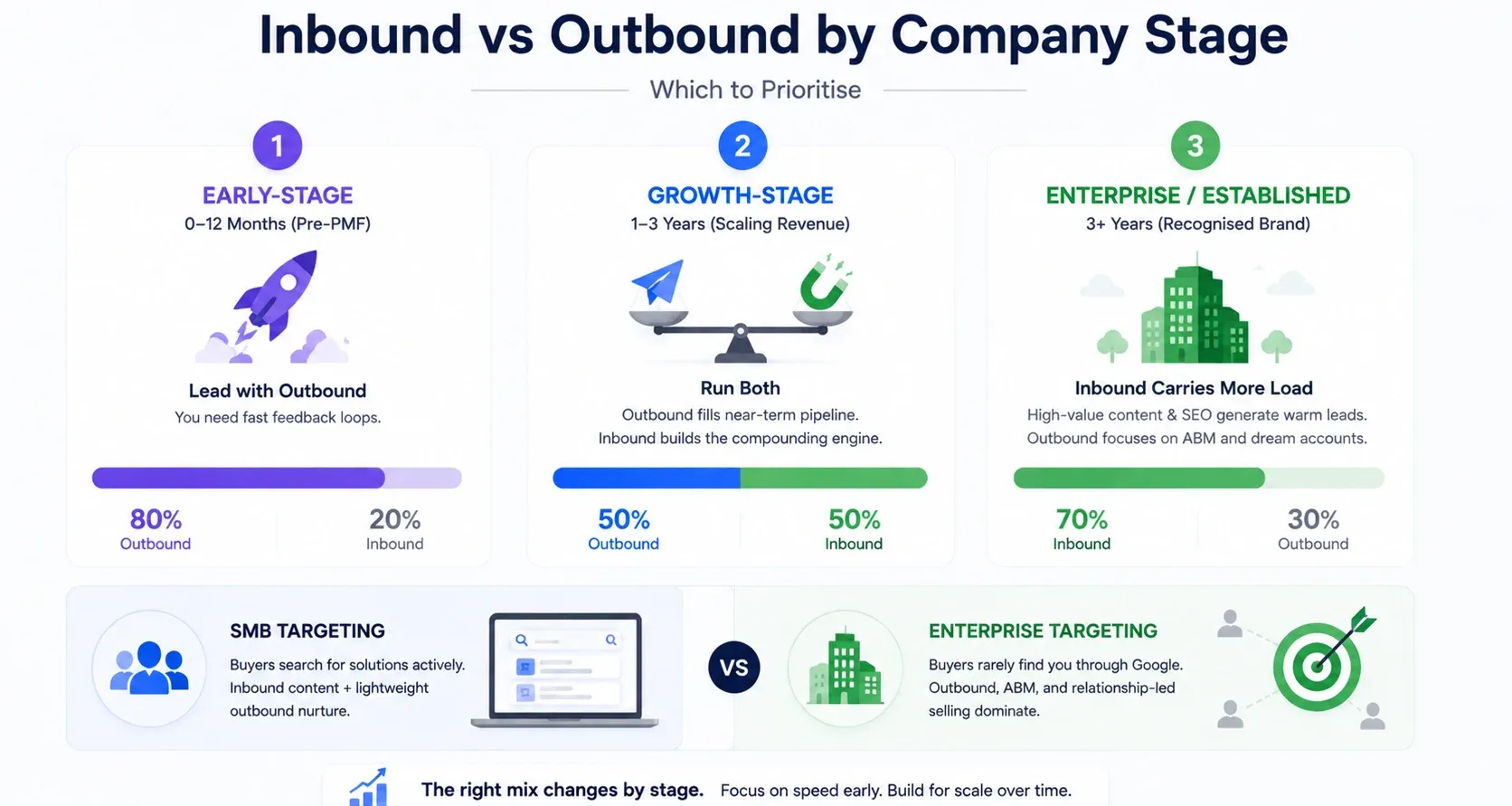
The right mix depends on where your company is not just what sounds better in a blog post.
1. Early-stage (0 to 12 months, pre-product-market fit)
- Lead with outbound. You need fast feedback loops.
- Outbound lets you test ICP, messaging, and value propositions in real conversations within days. Inbound takes too long to tell you anything useful.
2. Growth-stage (1 to 3 years, scaling revenue)
- Run both. Outbound fills the near-term pipeline. Inbound builds the compounding engine.
- The ratio shifts from roughly 80/20 outbound-heavy toward 50/50 as your domain authority grows.
3. Enterprise or established teams (3 years plus, recognised brand)
- Inbound carries more of the load. High-value content, case studies, and SEO generate warm leads.
- Outbound shifts toward ABM targeted campaigns to a short list of dream accounts, not broad sequences.
SMB vs Enterprise targeting
- → SMB buyers respond well to inbound (they search for solutions actively). Inbound content plus lightweight outbound nurture.
- → Enterprise buyers rarely find you through Google. Outbound, ABM, and relationship-led selling dominate here.
What Does Inbound vs Outbound Cost for B2B?
Cost is the most important and least discussed factor in this debate and the numbers are very different depending on your stage.
Here are realistic benchmarks from my experience working with B2B teams:
Inbound cost benchmarks
| Resource | Monthly cost range |
|---|---|
| SEO content writer (2 posts/month) | $1,500 to $4,000 |
| Content strategy and SEO tooling | $300 to $800 |
| LinkedIn thought leadership (ghostwriting) | $1,000 to $3,000 |
| Design and landing page support | $500 to $1,500 |
| Total monthly investment | $3,300 to $9,300 |
| Time to meaningful lead volume | 6 to 18 months |
Outbound cost benchmarks
| Resource | Monthly cost range |
|---|---|
| SDR salary (full-time, entry-level) | $3,500 to $6,000 |
| LinkedIn outreach tool (e.g. Bearconnect) | $100 to $500 |
| Prospecting data and enrichment tools | $200 to $600 |
| CRM and sequencing tools | $100 to $400 |
| Total monthly investment | $3,900 to $7,500 |
| Time to first qualified conversations | 2 to 4 weeks |
The key insight: outbound costs are front-loaded but predictable. Inbound costs spread over time but compound. Early-stage teams with tight runways almost always get better short-term ROI from outbound.
How Does Inbound vs Outbound Fit Into Sales-Led vs Product-Led Growth?
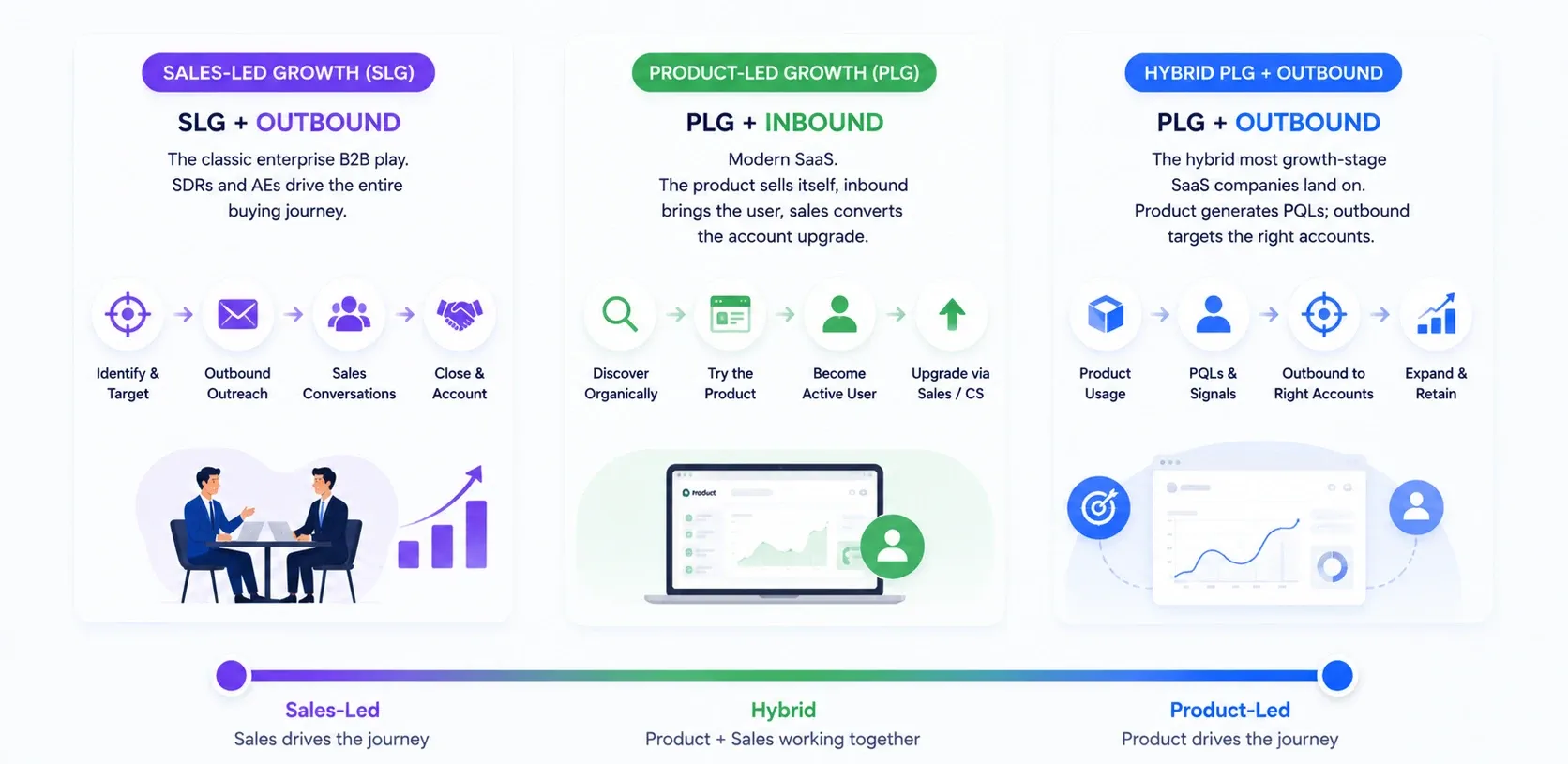
Sales-led growth (SLG) and product-led growth (PLG) are go-to-market motions not the same as inbound and outbound, but closely related.
- SLG + outbound = the classic enterprise B2B play. SDRs and AEs drive the entire buying journey.
- PLG + inbound = modern SaaS. The product sells itself, inbound brings the user, sales converts the account upgrade.
- PLG + outbound = the hybrid most growth-stage SaaS companies land on. Product generates user data and product-qualified leads (PQLs); outbound targets the right accounts before they churn or stall.
LinkedIn Outbound for B2B: What Actually Works in 2026
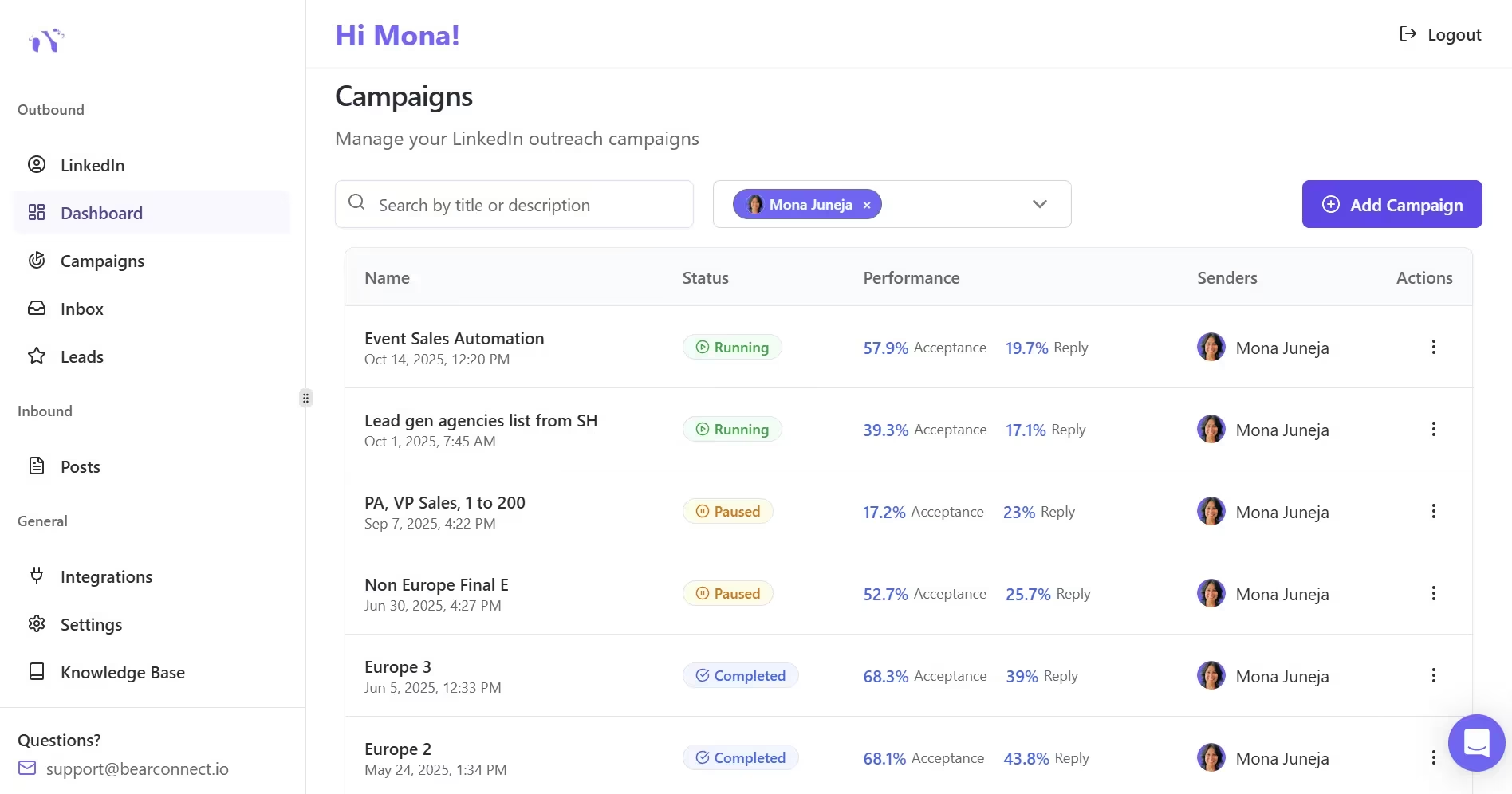
LinkedIn is the highest-ROI outbound channel for B2B in 2026, and most teams are still using it wrong.
The average B2B deal involves 6 to 10 decision-makers. Most of them are on LinkedIn daily. No other platform gives you this level of direct access with this targeting precision.
What works on LinkedIn outbound today
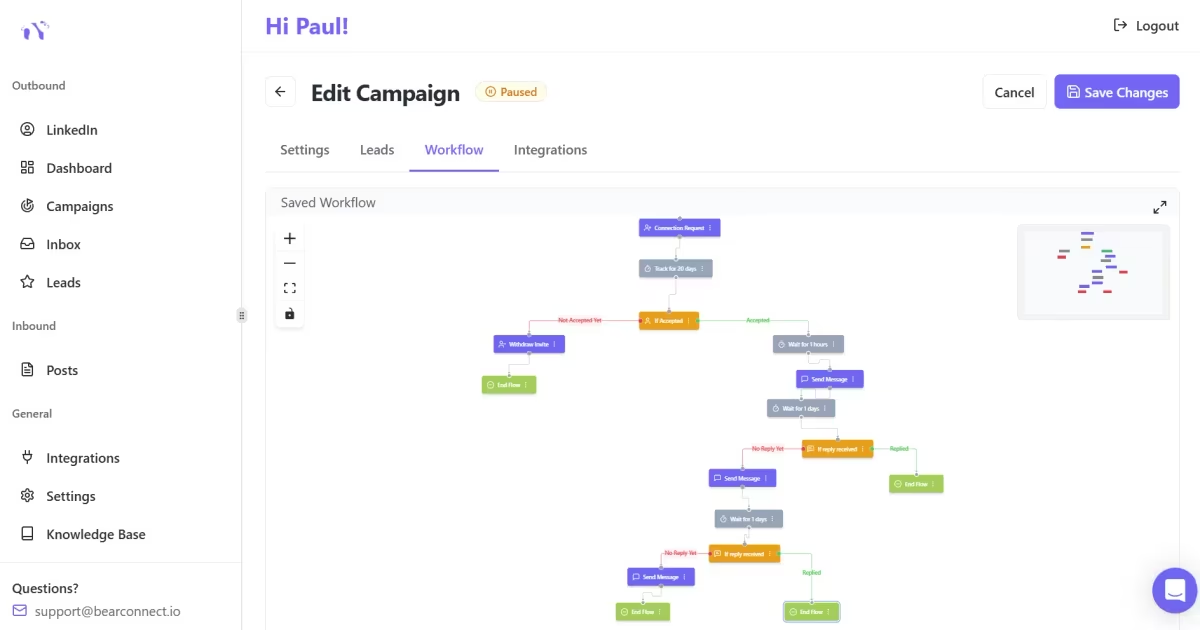
- Personalised connection requests with a specific, low-friction reason to connect
- Short, value-first first messages referencing something real from their profile or company
- Follow-up sequences spaced 3 to 7 days apart
- Content engagement before outreach: comment on their posts first, then connect
What does not work
- Connection request followed immediately by a three-paragraph pitch
- Generic "I came across your profile" openers
- Asking for a call in the first message
- Sending the same message to 500 contacts without personalisation
What Does a High-Converting B2B Outbound Cadence Look Like?
A strong cadence in 2026 is multi-touch, multi-channel, and spread over 2 to 3 weeks. Here is a 7-step sequence that books meetings:
- Day 1: LinkedIn connection request with a short, personalised note (no pitch)
- Day 3: Engage with their LinkedIn post (genuine comment, not generic)
- Day 5: LinkedIn message share one relevant insight or resource, no ask
- Day 7: Cold email problem-framing subject line, two sentences max, one clear CTA
- Day 10: LinkedIn follow-up referencing the email, keep it light
- Day 14: Second cold email with a different angle (case study, stat, or direct question)
- Day 18: Final LinkedIn message short break-up style, leaves the door open
Each touchpoint should feel like it is from a real person who has read their profile. Because it should be.
Pro tip: Engage with a prospect's LinkedIn content for 3 to 5 days before sending a connection request. Your acceptance rate can jump from 20 percent to over 45 percent with this one habit alone.
How to Run Account-Based LinkedIn Outreach
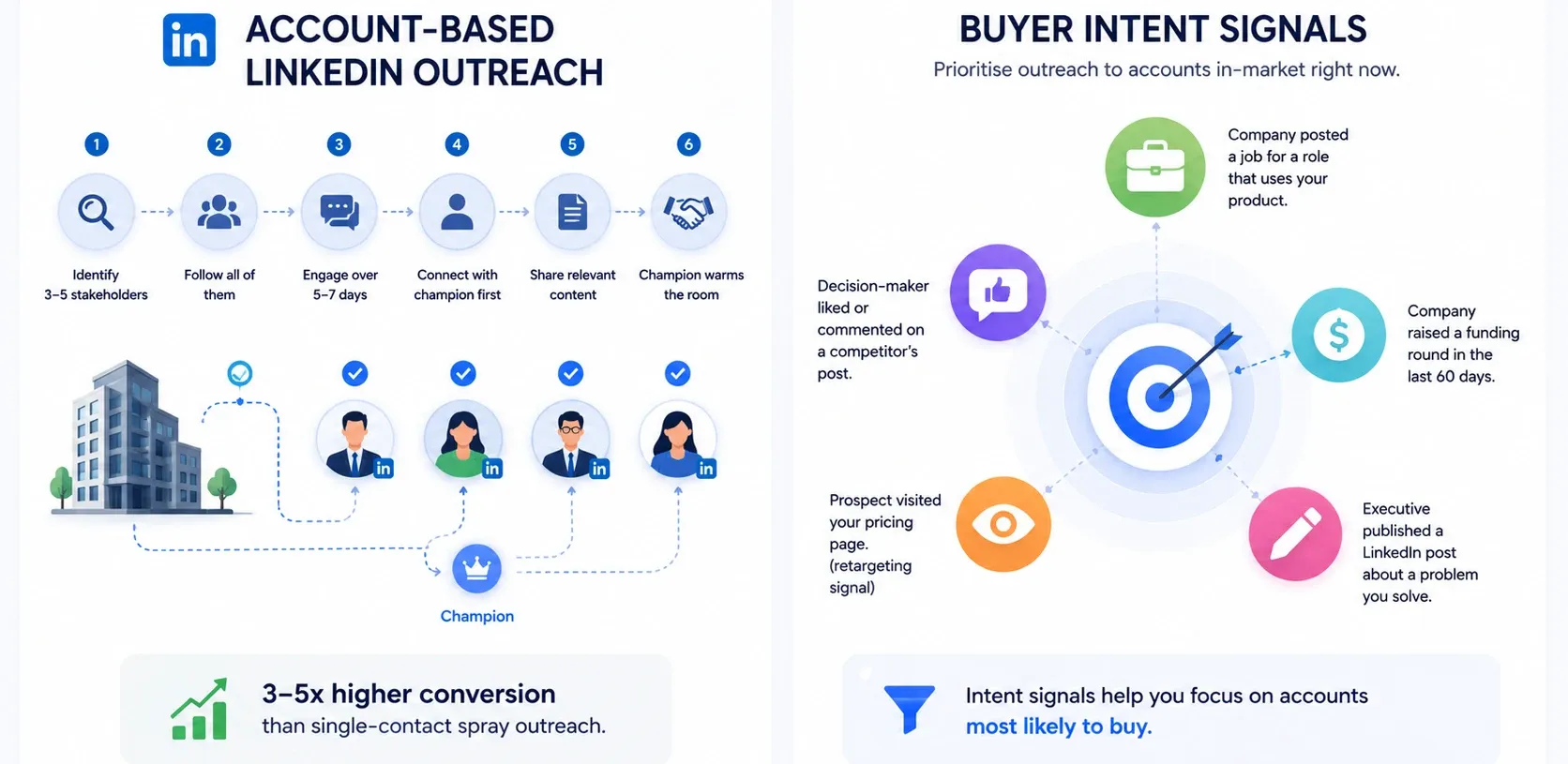
Account-based LinkedIn outreach targets all decision-makers in a single company simultaneously, not just one contact:
- Identify 3 to 5 stakeholders at the target account (economic buyer, end user, champion, blocker)
- Follow all of them on LinkedIn before connecting
- Engage with company content and individual posts over 5 to 7 days
- Connect with the most likely champion first, not the most senior person
- Once connected, share a relevant piece of content not a pitch
- Let the champion warm the room before you reach out to the economic buyer
This approach takes longer per account but conversion rates are 3 to 5 times higher than single-contact spray outreach.
Using Buyer Intent Signals to Prioritise Outbound
Intent signals tell you who is actively in-market right now. Use them to generate high-quality LinkedIn leads instead of guessing:
- → Company recently posted a job for a role that uses your product
- → Decision-maker liked or commented on a competitor's post
- → Company raised a funding round in the last 60 days
- → Prospect visited your pricing page (retargeting signal)
- → Executive published a LinkedIn post about a problem you solve
Managing multi-account LinkedIn outreach manually at scale is painful. Bearconnect handles multi-account management, personalised sequence automation, and inbox organisation from a single dashboard so your team focuses on conversations, not copy-paste.
What Is an SDR Outbound Playbook in 2026?
An SDR outbound playbook is a repeatable, documented system for turning cold prospects into booked meetings and in 2026, a working playbook has six components.
- ICP definition. Industry, company size, revenue, job title, geography, tech stack. The tighter, the better.
- Lead sourcing. LinkedIn Sales Navigator, intent data tools, and account lists filtered by ICP criteria.
- Channel mix. LinkedIn first (highest response rates in B2B), cold email second, phone for high-value accounts.
- Sequence structure. Five to seven touches over 14 to 18 days. First touch: connection request with a short note. Middle touches: value-led follow-ups. Final touch: breakup message or case study.
- Personalisation layer. AI tools generate a relevant first line per prospect based on their profile, post activity, or company news.
- Inbox management. Every reply routed to one place so nothing falls through. This is where most SDR teams bleed pipeline.
Bearconnect handles steps 3 through 6 from a single dashboard across multiple LinkedIn accounts, with drip sequences that pause automatically when a prospect replies.
How Is AI Changing Inbound and Outbound Sales in 2026?
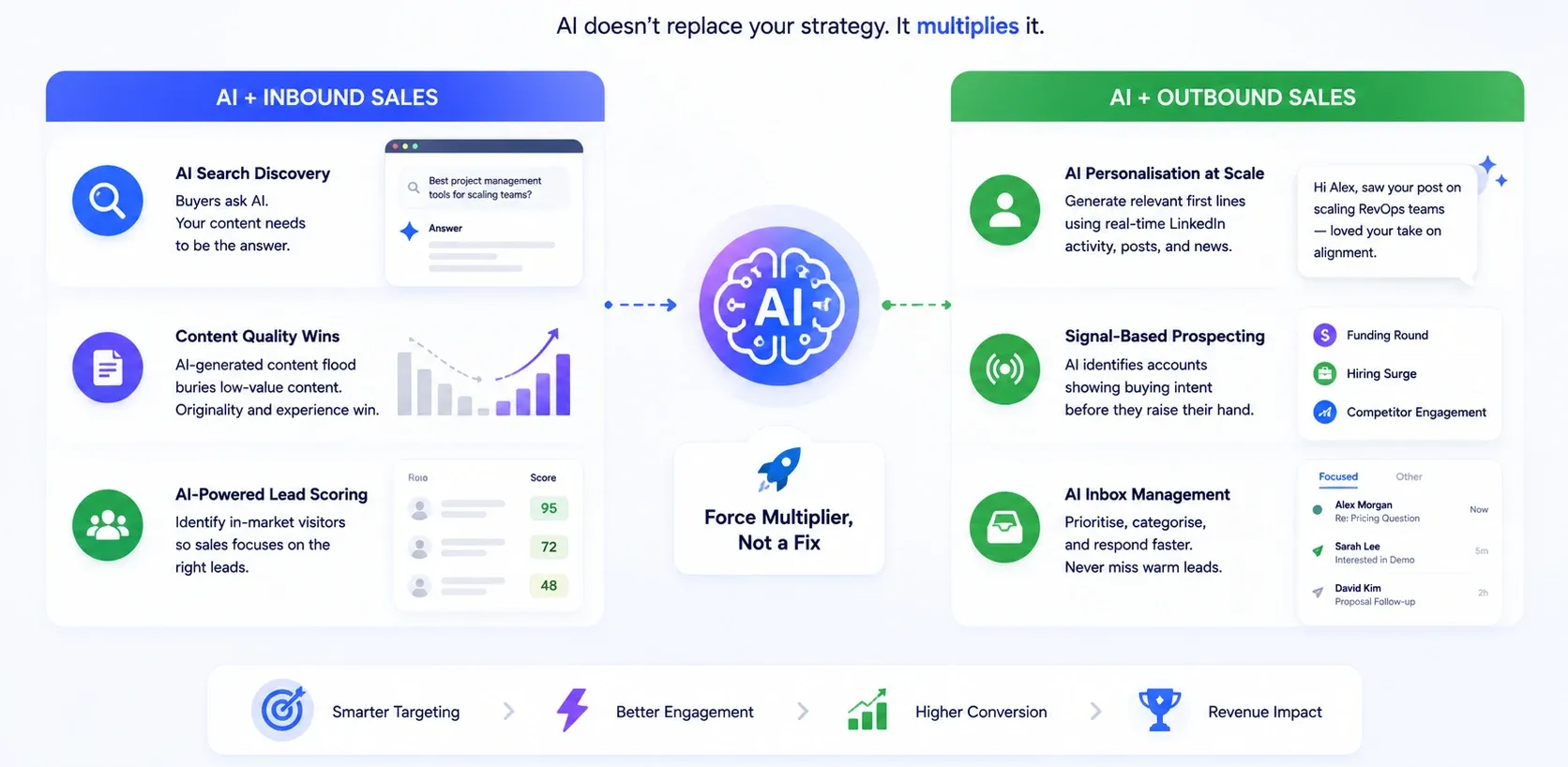
AI has not replaced inbound or outbound it has made both dramatically more effective when used with intent, and dramatically more wasteful when used without it.
AI and inbound sales
- AI search discovery is the biggest shift. Buyers now ask ChatGPT and Perplexity questions instead of Googling. Your content needs to appear in AI-generated answers BLUF formatting, direct-answer paragraphs, and structured headings all help.
- AI-generated content flood means lower-quality inbound content gets buried faster. Depth, original perspective, and first-person experience signals matter more than keyword volume.
- AI-powered lead scoring lets inbound teams identify which website visitors are actually in-market so sales can prioritise follow-up.
AI and outbound sales
- AI-assisted personalisation at scale is real now. You can generate a relevant first line per prospect in seconds based on their LinkedIn activity, recent posts, or company news.
- Signal-based prospecting uses AI to identify accounts showing buying intent before they raise their hand funding announcements, hiring patterns, competitor engagement.
- AI inbox management helps teams handle higher reply volumes without missing warm leads.
The bottom line: AI is a force multiplier. It does not fix bad strategy.
How to Build a Hybrid B2B Sales Strategy in 2026
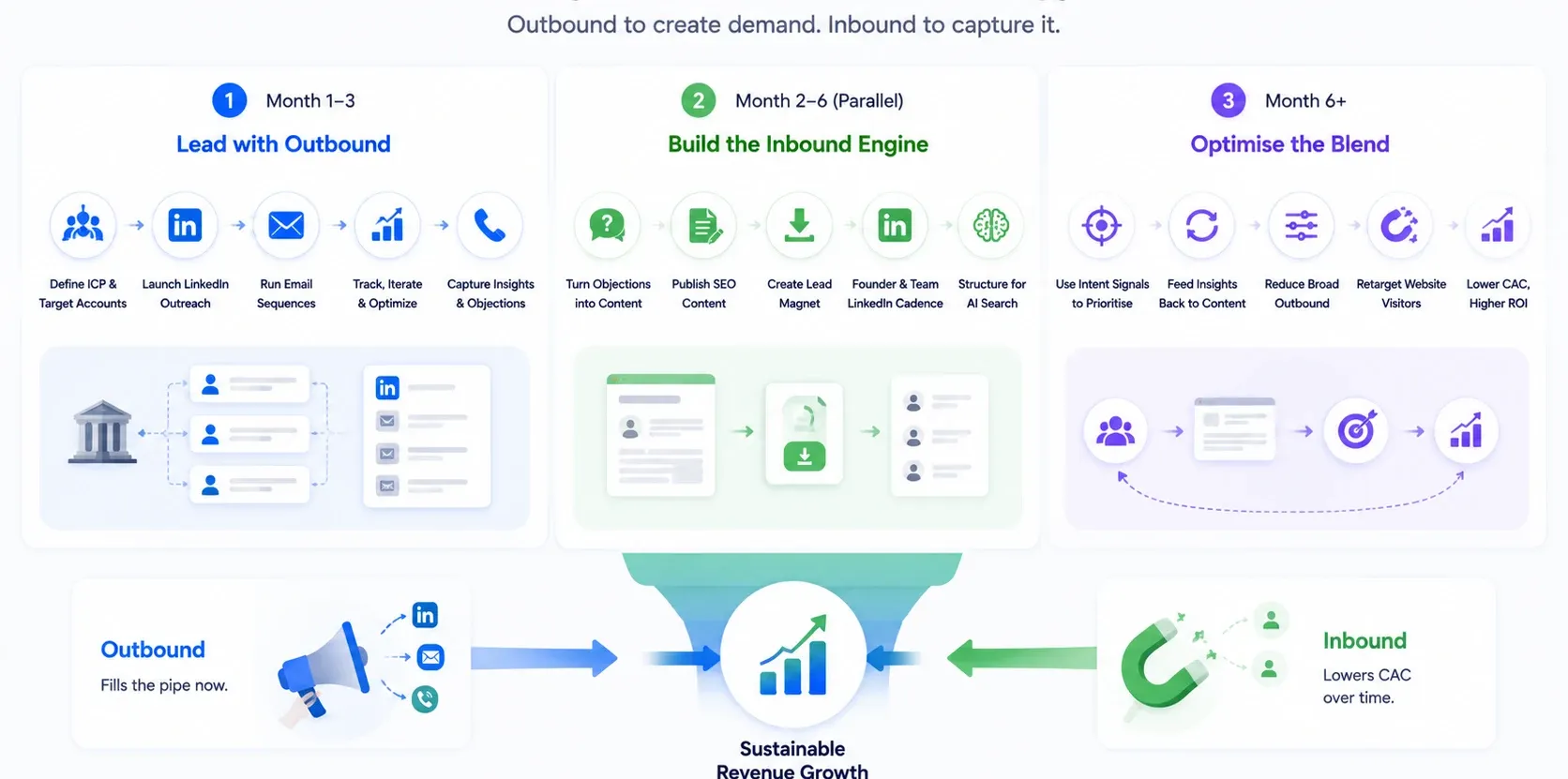
The most scalable B2B revenue model in 2026 is a coordinated hybrid outbound to create demand, inbound to capture it.
Month 1 to 3: Lead with outbound
Resources needed: 1 SDR or founder doing outreach, a LinkedIn outreach tool like Bearconnect, a data provider for prospect lists.
- Define your ICP tightly: industry, company size, job title, tech stack, geography
- Build a target account list of 200 to 500 companies per quarter
- Launch LinkedIn drip sequences from multiple accounts. Personalised and value-led.
- Run parallel cold email sequences for prospects not active on LinkedIn
- Track reply rates and meeting conversions every week kill what does not work, scale what does
- Document every objection, hesitation, and question you hear on calls
Month 2 to 6 (parallel): Build the inbound engine
Resources needed: 1 content writer, SEO tooling, LinkedIn posting cadence from a founder or subject-matter expert.
- Turn your outbound objections into SEO content topics and LinkedIn posts
- Publish 2 to 4 blog posts per month targeting commercial-intent keywords your buyers actually search
- Create 1 lead magnet (playbook, template, checklist) for email capture
- Automate LinkedIn posts 3 to 5 times per week from founder and team accounts
- Structure every piece for AI search direct answers first, explanation second
Month 6 and beyond: Optimise the blend
- → Use buyer intent signals from inbound (content downloads, site visits) to prioritise outbound targets
- → Feed outbound conversation data back into content topics
- → Reduce broad cold outbound volume as inbound scales, but never stop entirely
- → Run retargeting ads to outbound prospects who visited your website but did not convert
Outbound fills the pipe now. Inbound lowers your CAC over time.
How Do You Measure Inbound vs Outbound Sales Performance?
You cannot optimise what you do not measure and inbound and outbound require completely different KPI frameworks.
Inbound KPIs to track
| Metric | What it tells you |
|---|---|
| Organic traffic to key pages | Content reach and SEO momentum |
| MQL to SQL conversion rate | Lead quality from inbound channels |
| Inbound demo booking rate | Offer strength and landing page performance |
| Content-assisted pipeline | Revenue influenced by content touches |
| CAC payback period (inbound) | How long it takes to recoup inbound investment |
Outbound KPIs to track
| Metric | What it tells you |
|---|---|
| Connection acceptance rate (LinkedIn) | Relevance of targeting and first message |
| Reply rate per sequence | Message quality and offer clarity |
| Meeting booked rate | Full funnel efficiency from first touch to call |
| Opportunity creation rate | How many outbound convos become real pipeline |
| Cost per meeting booked | Efficiency of your outbound spend |
The one number that ties both together
Sales velocity = (Number of deals x Average deal value x Win rate) / Sales cycle length
- → Number of deals: outbound gives you control. You choose the volume.
- → Average deal value: inbound attracts self-serve buyers (smaller deals). Outbound lets you target enterprise accounts directly.
- → Win rate: inbound leads close at higher rates because they are pre-educated.
- → Sales cycle length: inbound cycles are typically longer. Outbound with tight targeting can be shorter.
Pro tip: Track sales velocity per channel separately every quarter. If your inbound leads have a 60-day cycle and outbound leads have a 30-day cycle, that tells you exactly where to invest next.
Common Mistakes B2B Teams Make With Inbound and Outbound
Most B2B teams fail not because they chose the wrong channel, but because they executed poorly within the right one.
Inbound mistakes and how to fix them
| Mistake | Fix |
|---|---|
| Publishing content without a keyword or intent strategy | Map every piece to a real search query or AI-tool question |
| Writing for Google without writing for the buyer's decision journey | Structure every post to answer the full question, not just rank for it |
| No lead capture on high-traffic pages | Add a contextual CTA or content upgrade on every top-performing page |
| Treating LinkedIn and SEO as separate strategies | Repurpose every blog post into 3 LinkedIn posts; let each channel feed the other |
| Measuring inbound on outbound timelines | Give inbound 6 months before calling it dead |
Outbound mistakes and how to fix them
| Mistake | Fix |
|---|---|
| Targeting too broadly, burning through your TAM | Tighten your ICP to 3 firmographic filters before building any list |
| Sending too many touchpoints too quickly | Space touchpoints 3 to 5 days apart; 7 touches over 18 days is the sweet spot |
| No follow-up system after initial conversations | Build a CRM stage for "replied but not booked" |
| Failing to track reply rates by message variant | A/B test your opening lines; kill underperformers after 50 sends |
| Running outbound without a unified inbox | If a prospect replies and nobody sees it for two days, you wasted the entire sequence |
Wait, You Might Be Thinking: "Can I Just Pick One and Go All In?"
You can. But you will cap your growth faster than you expect.
All-outbound teams hit a ceiling when they max out SDR capacity and every new meeting costs the same as the last. All-inbound teams hit a wall when organic traffic plateaus or an algorithm shift kills rankings overnight.
The 2026 reality is that both channels have gotten noisier. Inbound competition is fierce everyone uses AI to publish more content. Outbound inboxes are crowded everyone uses AI to send more messages.
The teams winning right now are not doing more of one thing. They are doing both things well.
Inbound vs Outbound: Which Strategy Wins in 2026?
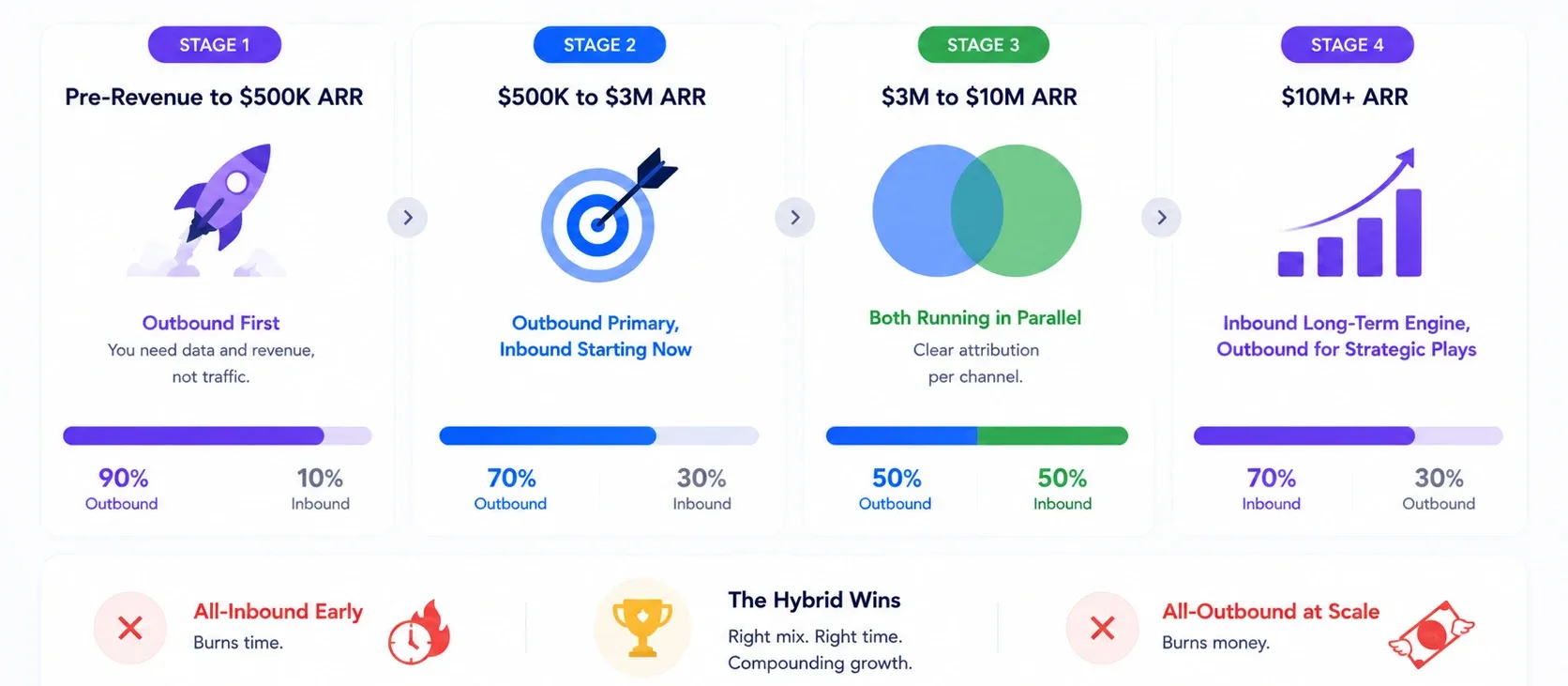
Neither wins alone. The strategy that wins is the one that matches your stage, your ICP, and your timeline.
Here is my honest recommendation by company stage:
- Pre-revenue to $500K ARR: Outbound first. You need data and revenue, not traffic.
- $500K to $3M ARR: Outbound as primary engine, inbound content starting now.
- $3M to $10M ARR: Both running in parallel with clear attribution per channel.
- $10M+ ARR: Inbound as the long-term compounding engine, outbound for enterprise and new verticals.
The companies stuck in all-inbound mode at early stage are burning time. The companies stuck in all-outbound mode at scale are burning money. The hybrid wins.
Frequently Asked Questions
1. What is the main difference between inbound and outbound sales for B2B?
Inbound attracts buyers already searching for a solution using content, SEO, and brand presence. Outbound involves proactively reaching out to target accounts that match your ICP. Inbound relies on pull; outbound relies on push. In 2026, most winning B2B teams use both in coordination.
2. Which is more cost-effective for B2B: inbound or outbound?
Inbound has a lower cost per lead over time because content compounds. Outbound has a higher short-term cost but delivers faster pipeline. For early-stage companies under $3M ARR, outbound is usually more cost-effective because it generates revenue before inbound has had time to build momentum.
3. Is cold outreach still effective in B2B in 2026?
Yes, when it is targeted and personalised. The spray-and-pray era is over. Cold outreach effectiveness depends on tight ICP targeting, multi-channel sequencing (LinkedIn plus email), personalisation at scale, and fast follow-up on every reply. Teams running it right still see 20 to 30 percent acceptance rates on LinkedIn.
4. What is the best B2B sales strategy for startups in 2026?
Lead with outbound for immediate pipeline and build inbound content in parallel. Shift the balance toward inbound as your brand authority and organic traffic compound over 6 to 12 months. The ratio starts 80/20 outbound-heavy and moves toward 50/50 over time.
5. What tools work best for B2B LinkedIn outreach in 2026?
The best LinkedIn outreach tools combine personalised sequencing, multi-account management, and inbox management in one place. Bearconnect is built specifically for this: it allows teams to run targeted outbound campaigns on LinkedIn with personalised follow-ups, manage multiple accounts safely, and keep all replies organised in a unified inbox so no warm lead slips through.
The Verdict: Build Both, Start With What Gets You Meetings This Month
The inbound vs outbound debate ends when you stop treating them as competitors and start treating them as two halves of the same revenue engine.
If you are starting from zero, lead with outbound. If you already have traffic, layer outbound on top to accelerate.
Try Bearconnect free at bearconnect.io to run the outbound side of that equation from one dashboard.
Ready to Transform Your LinkedIn Strategy?
Join thousands of professionals already using Bearconnect to automate their outreach and grow their network.
7-day free trial • Cancel anytime
Related Articles
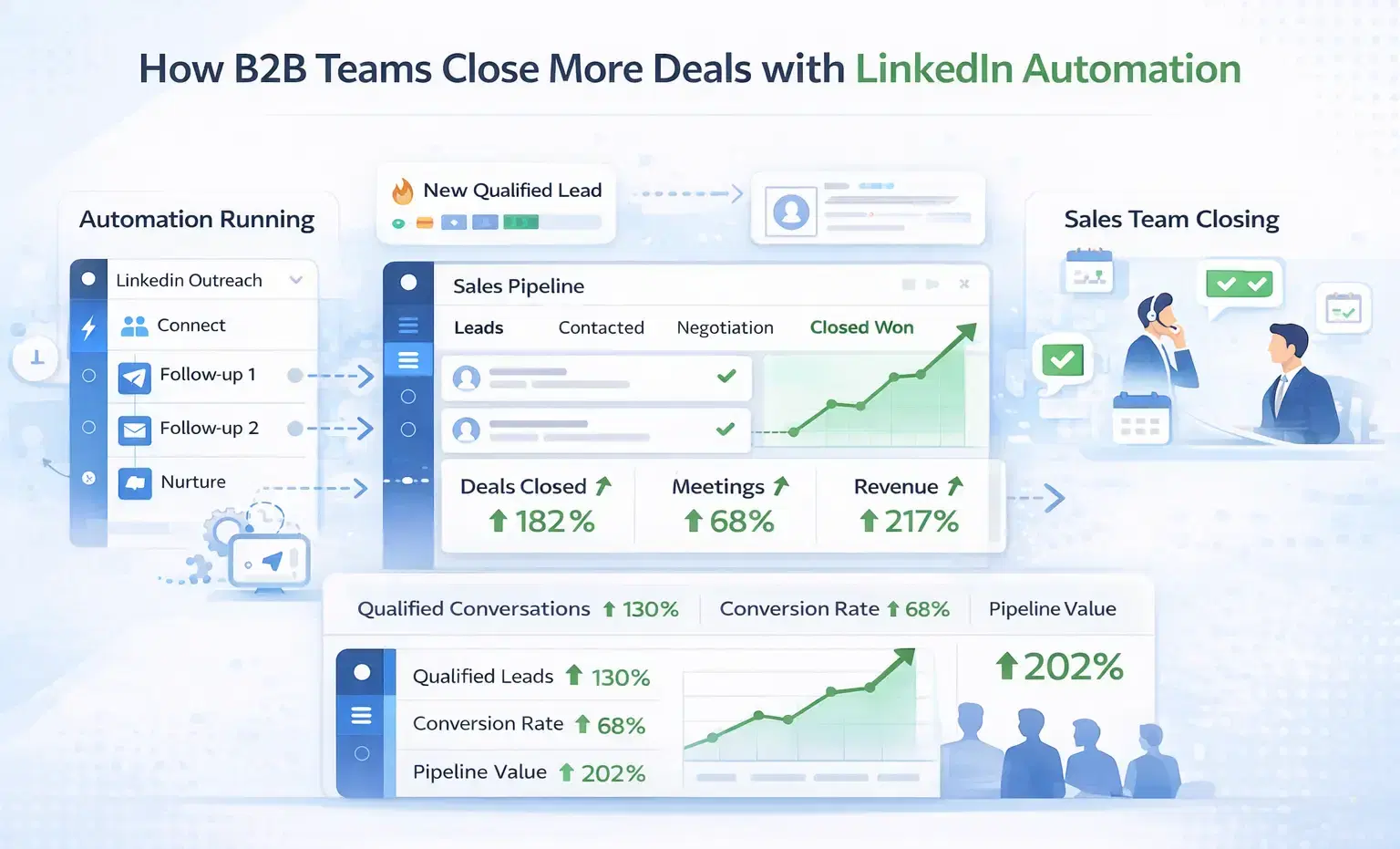
How B2B Sales Teams Close More Deals by Automating LinkedIn Outreach?
B2B sales teams waste hours on manual LinkedIn outreach. Automation fixes that more meetings, less grind, better conversions at scale.
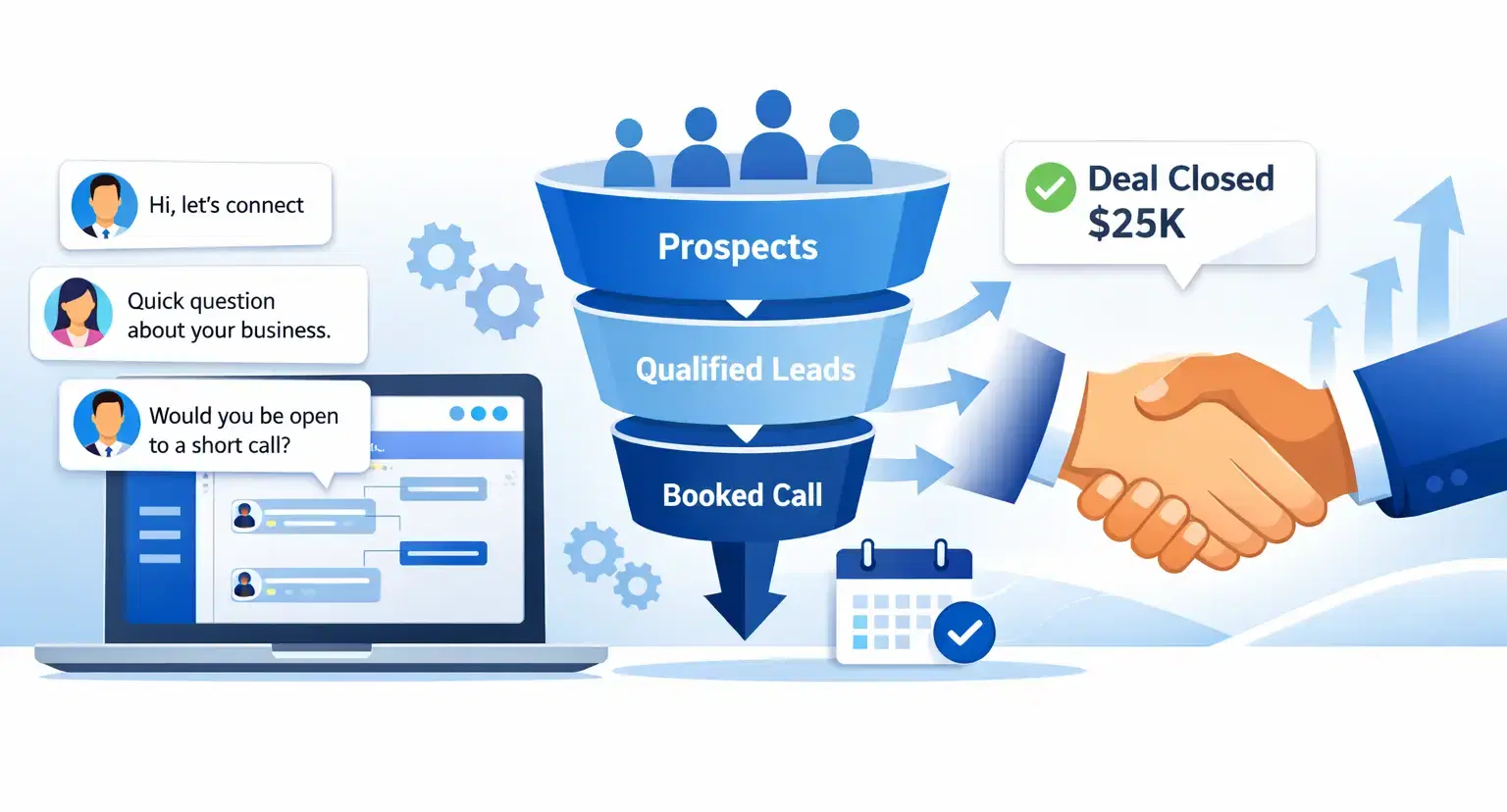
High Ticket Sales on LinkedIn: How to Close Big Deals with LinkedIn Automation
Learn how to close high-ticket B2B deals on LinkedIn using smart automation, lead qualification, and proven outreach strategies that turn prospects into booked calls.